
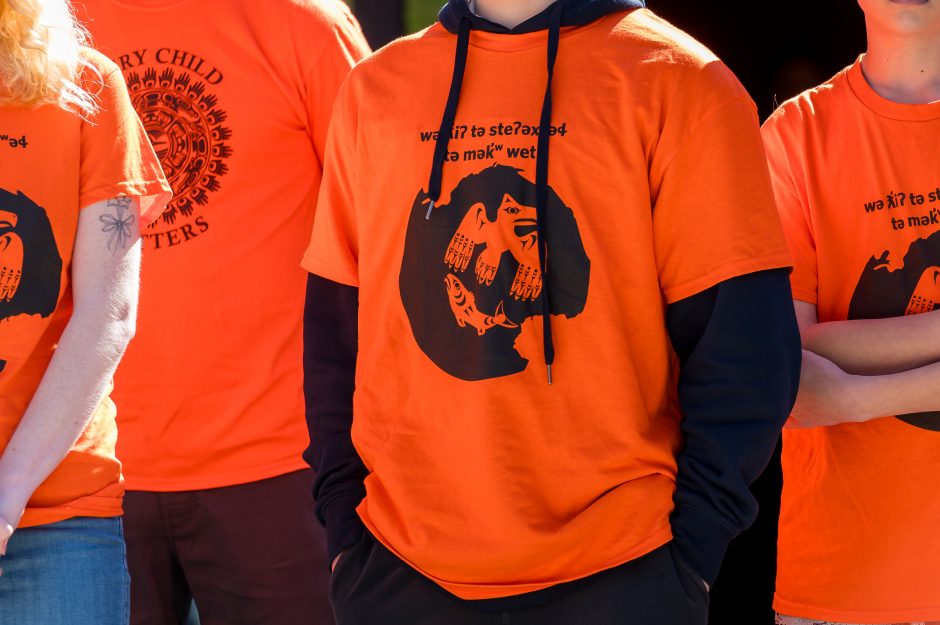
Between the late 1800s and 1996, more than 150,000 First Nations, Métis and Inuit children attended Indian Residential Schools. Orange Shirt Day/ the National Day for Truth and Reconciliation, held each year on September 30, commemorates this legacy.
Phyllis Webstad began Orange Shirt Day to honour the Survivors and intergenerational Survivors of residential schools, and remember those children who never made it home. Orange Shirt Day is an opportunity for people of all ages, backgrounds, and cultural identities to engage with the legacies of the Residential School System.
These resources are a starting point to explore, learn more about residential schools, and begin a dialogue. Share these resources and your learnings with your friends, colleagues, and family. Below are educational resources and learning activities for children and people of all ages to learn about the legacies of the Residential School System.

Early Years
- Color a t-shirt (PDF)
- Use the colouring sheets or crossword from Medicine Wheel Education (PDF)
- Explore the Orange Shirt Society’s teaching guides
- Make an attachment heart
- Read or watch When we were alone (video below)
When We Were Alone Discussion Questions
- In the story, the words used to describe the narrator’s grandmother are kókum and Nókum (“grandmother” and “my grandmother”). These are the words in Nókum’s language which is Cree. What words do you use for grandmother in your language?
- How do you think Nókum felt when she was made to wear different clothes and speak a different language at school? Did Nókum have a choice about what she wore or what language she spoke?
- What are some of the things Nókum did with her family before she went away to residential school? Why was Nókum separated from her brother?


Middle Years
- Write a letter to your MP to ask for more progress on TRC Calls to Action. Find your MP.
- Explore the resources in My Name is Seepeetza.
- Read the Phyllis’ Story from the Orange Shirt Society.
- Explore historical sites in BC such as residential school markers – are there any near you?
Phyllis’ Story Questions for Discussion
- Where was Phyllis from? What was the name of her home community?
- What happened to Phyllis’s orange shirt when she arrived at school? How did this experience make Phyllis feel?
- How do you think Phyllis and other children felt while at school?
- Why is it important to Phyllis to share her story? What impact does it have on others to hear it?
- How do you think hearing support for Phyllis and her story will impact the lives of other Residential School Survivors?
- When a person chooses to wear an orange shirt on Orange Shirt Day, what statement are they making?

Secondary Years
- Ask your relatives about what they learned about residential schools.
- Watch the Residential Schools Timeline Video (video below) and then tell someone else about what you learned.
- Find out if there was a residential school near where you live. Look at the distances between schools and communities.
- Having trouble finding words to express what you learned? Make some art.
- Watch Phyllis Webstad and hear her testimony
Residential Schools Timeline Video Discussion Questions
- Did you find a residential school in your area? If so, does this come as a surprise to you? If not, where was the nearest residential school?
- Do you have an older relative who remembers a residential school in your area? What were their perceptions about residential schools?
- Take some more time to reflect on the location of your city, town, or community. In whose traditional territory do you reside? What is the language spoken?

Post-Secondary Years
- Watch The Road Forward
- Choose a BC school to explore and learn about in our records and collections.
- Listen to Survivor testimony in the Legacy of Hope collection (video below)
- Read the United Nations Declaration on the Rights of Indigenous Peoples (UNDRIP)
- Make a collage about Orange Shirt Day using historical photos, maps or other information
- Explore the mental health services or approaches at CMHA
- Read the TRC Calls to Action and look into how your university has implemented the calls
Discussion and reflection questions
- Choose a survivor testimony from the Legacy of Hope Foundation. When doing so, please remember to practice good self care (whatever that looks like for you) before, during and after listening as these stories can be difficult to listen to.
- While listening, it might be a good idea to draw as you listen, paint, sing or write poetry to help you process what you have heard.
- How did you feel while listening to the story?
- Who was the story about and what was their home community?
- How did the Residential School experience impact the life of the story teller and the lives of those around them?
Read the TRC’s Calls to Action and choose one to focus on.
- Which action have you chosen and why?
- Why do you feel it is significant to act upon these calls?
- Who does this call impact and how?
Additional Resources
UBC’s X̱wi7x̱wa Library has more educational and research materials to help you continue your learning about Orange Shirt Day and the ongoing impacts of the Residential School system.
Start with their “Orange Shirt Day is Every Day” resource.
Then, use their research guide on Indian Residential Schools in Canada to learn more.